Archive for the ‘General’ Category

More Proton Treatments Centers on the way!

Saturday, May 12th, 2007

Over the past year I lost 30 pounds and my Prostate is happy.

The obvious step for anyone is to keep in shape and lose extra body fat to help fight Prostate cancer before and after treatment.

I went to a web site http://www.mywalkingmusic.com/ where I found lots of help in overcoming extra weight and using regular walking as a great way to lose the pounds. They have put their music in a walking format at different paces 128, or 118 steps to suit your age and condition. So, I put one of their many CDs in my jogging player, walk for at least 30, sometimes 45 minutes every other day and help myself stay well.

MORE NEW PROTON TREATMENT CENTERS ON THE WAY!

The latest news is that the University of Oklahoma Health Sciences is installing a Proton center. They say, “The University of Oklahoma Health Sciences Center’s selection of Still River’s System places OU among the nation’s leading medical schools choosing the system, including Washington University School of Medicine (St. Louis), Tufts School of Medicine (Boston) and Robert Wood Johnson School of Medicine (New Jersey).

In addition, the Still River Systems equipment will be placed at the new M.D. Anderson Cancer Clinic in Orlando, Florida”.

On September 05, 2006 a Press release titled, “A Cheaper Way to Zap Tumors”, said in part, “Half of all cancer patients in the United States require radiation to combat their tumors. A form of radiation that uses protons, rather than X rays, to zap tumors causes fewer side effects to healthy tissue and may prove more effective. ( I believe that if they talk to the men who swear by Protons, including me, “May” will change to “will”.) Now a startup based in Littleton, MA, Still River Systems, is working with MIT physicists to develop a smaller, less expensive proton accelerator in the hopes of making the therapy more widely available. It expects the machine, which relies on advances in magnet technology to energize protons enough so they are therapeutic, to be in hospital trials in 2008.”

The above statements appear to tie in with the University of Oklahoma’s release.

For those of you that are reluctant to decide – Protons are here to stay!

I just suggest one thing: if your Doctor, Urologist, or Oncologist cannot tell you the difference between X-Rays and Protons, you can tell whomever it is that they really need to learn the advantage of minimal to NO tissue damage using proton radiation!

Is Emory Unaware of Proton Therapy?

Saturday, April 28th, 2007

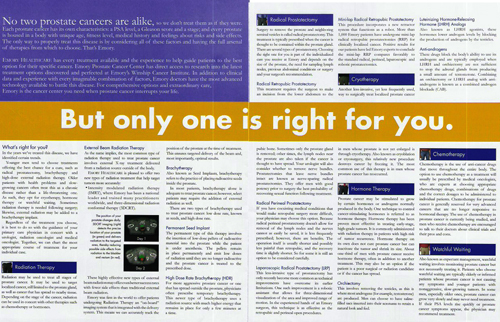
Here’s a classic example of how the medical community continues to suppress information about Proton Therapy. Below a recent advertisement from Emory University’s Prostate Center:
emoryprostate.jpg
It lists five primary methods of treatment (“but only one is right for you”): Radiation Therapy, Radical Prostatectomy, Cryotherapy, Hormone Therapy, Chemotherapy, and Watchful Waiting.
Absolutely no mention, even in passing, of Proton Therapy. Now there are two possibilities here. Either Emory is unaware of Proton treatment options (which I find highly unlikely), or they have purposely chosen to omit the fact that proton therapy is a viable option. At the least this is deceiving, but it borders on medical negligence. Why would Emory fail to mention protons? Because Emory can not provide proton therapy at their facilities, therefore they are not financially motivated to point it out as an option. In my mind, this is the number one reason why the spread of information on protons has progressed so slowly.

WHY ARE “PROTONS” BETTER?

Monday, April 2nd, 2007

I think Dr. Carl Rossi, my doctor at Loma Linda, nails it in the March edition of PROSTATE CANCER COMMUNICATION NEWSLETTER – VOLUME 23, NUMBER 1 – March 2007. This is an extract from the entire article used with Dr. Rossi’s permission:

“The differences Between Protons and X-Rays – In order to understand the advantages of proton beam therapy, it is necessary to delve somewhat into the fundamentals of x-rays and protons and their interactions with human tissue. X-rays are, essentially, high energy forms of visible light. X-rays are massless, and do not possess an electrical charge. Because of this they are highly penetrating and it is indeed their ability to penetrate the human body which makes them such useful diagnostic tools. As an X-ray enters the body, the energy of the beam is rather slowly dissipated by interacting with bone and soft tissue. However, there is typically some energy that passes completely through the body. If the goal is diagnosis, this is a useful property because it is the x-ray energy that leaves the body that can be captured and analyzed to provide a picture of the internal organs along the beam’s path. However, what is desirable in diagnosis is not necessarily desirable in therapy because that same beam is delivering radiation to everything within its path, be it normal tissue or tumor. Again, this is true of all types of x-ray therapy including IMRT – while with IMRT we can vary the intensity of the beam so that the dose rate as the beam passes through particularly critical normal tissues may be low, what we cannot do, and what is indeed impossible to do, is to get that x-ray beam to stop within the body. IMRT in fact represents the latest in a series of elegant compromises between that radiation dose we want to give to the tumor and that which the normal tissue will tolerate – it reduces the volume of normal tissue receiving a high radiation dose at the expense of increasing the volume of normal tissue receiving low to moderate doses. What would be ideal, from a treatment standpoint, would be a form of radiation which would deliver zero dose to the tissues in front of the target, 100% dose to the target, and zero dose beyond the target and this ideal is and always will be an impossibility with x-rays.

It is, however, far more achievable with protons. A proton is a subatomic particle with a discreet mass and an electrical charge, and these two properties radically influence the proton-human tissue interaction. When a beam of high-energy protons enters the human body, the radiation dose delivered to tissue proximal (in front of) the target is low, because at that point the protons are still traveling with a high velocity and therefore have little interaction with the tissue they are passing through. By attenuating the beam so that the protons are brought to a stop as they pass through the target (this is accomplished by passing the beam through a series of patient-specific anatomic compensators before the beam enters the patient) the radiation dose is maximized, and the protons (by virtue of exhausting their kinetic energy) come to rest just beyond the distal (far) edge of the target, the exit dose is zero. From a practical standpoint, the “internal dose” (total does to normal tissue) in a proton beam treatment plan for prostate cancer is three to five times less than that which is common when sophisticated x-ray therapy plans (utilizing IMRT) are employed. Again, this reduction in normal tissue dose means that the radiation dose given to the tumor can be increased with relative safety, and indeed the benefits of such dose escalation in early stage prostate cancer will be discussed shortly.”

“Three to five times less” this is exactly what I experienced in 1999, negligible to no damage and over seven and one-half years later, NO SIDE EFFECTS.

Jim Tuggey
April 2, 2007

New INFORMATION about a “proven Prostate cancer treatment” is what this web site is all about!

Tuesday, March 6th, 2007

Recently one diagnosed Prostate Cancer man asked about “Hype”? on my web site. In my Webster, the key definitions of Hype are “Deceive, publicize”.

Here’s what I say; yes I tell men about “protons” so you could say I publicize, “bring to public attention” information about Proton Therapy. But let me make it clear that I receive NO money, NO benefits, NO inducement for my www.prostateproton.com site. My interest in telling others about Protons and supporting the Proton treatment program is all my passion and joy at my results and has always been so since the beginning of the Web site.

I hope that all of you seek a second opinion. YOU have to make the decision regarding your treatment. If it were me, I’d listen to your doctor and then get a second opinion from a Proton Therapy Center. If your doctor or doctors don’t know about protons, you can ask a Proton expert at the Proton therapy sites listed on the “Links” page on www.prostateproton.com.

The FACTS are that Loma Linda is the “leading” Prostate treatment center using Protons in the world and through December 2006 has treated a total of 11,562 patients with protons. Of that number 7,743 (67 percent) were Prostate Cancer patients.

Also, there are five, ten and fifteen year reports published that show that Proton Therapy meets or betters any other treatment and has the superior advantage of reduced side effects.

The latest buzz is Robotic Surgery for Prostate cancer which, just like anything else, needs a track record. Protons have been around since 1961 and Robotic Laparoscopic Surgery since 2002, a boon to steady the hands of surgeons – it’s still surgery. As Bob Marckini says, “The way I look at robotic laparoscopic surgery is that it’s just a fancier way to make a ‘buggy whip’ – i.e. it’s a slicker way of doing something that’s gone out of style.

When I went through Loma Linda beginning in July 1999, I had waited almost a year from diagnosis. We had ages ranging from 40 to 90, so at Loma Linda that hasn’t changed to my knowledge while other centers may have different protocols. I do know that the beauty of the Proton is that it is well tolerated at any age.

Effectiveness and outcome of prostate treatment using Protons (or almost any other treatment methodology), depends on your condition when being treated. I was 69 when treated in 1999, in good shape and now I am 77. The results normally depend on your PSA, Gleason Score and Staging. My PSA was 15.9, my Gleason 6, my Staging T1C. As of Nov. 2006 my PSA is less than 0.2.

My case is explained at my web site at www.prostateproton.com.

Read Bob Marckini’s great book about his Proton experience and it can be found at the www.protonbob.com web site. I hope all of this helps you in making your own decision.

Jim Tuggey
Web site owner www.prostateproton.com
March 1, 2007

You Can Beat Prostate Cancer and You Don’t Need Surgery to Do it

Saturday, January 20th, 2007

Bob Marckini, founder of BOB (brotherhood of the Balloon) has delivered a rich reward for men “at risk” and “diagnosed” with Prostate Cancer.  His BRAND NEW book You Can Beat Prostate Cancer and You Don’t Need Surgery to Do it, is immediately available at www.protonbob.com.

Bob’s  research is absolutely invaluable and his experiences may save your life!, so let’s look at some of his key points. [Notes are mine.]

Become Your Own Advocate

This is perhaps the most important message of this book. You need to take charge of your own treatment decision.  No single treatment is best for everybody.  In the case of prostate cancer, you have several treatment alternatives, and there is only one person on this planet who is qualified to choose the option that is best for you. You! But you need to do your homework first, so that you are comfortable with your decision.

The most important thing a man can do to ensure early detection is to have annual physical examinations that include blood PSA measurement and DRE (digital rectal exam).  [ NOTE: Bob recommends that you start at 45 but when I was treated we had a 40 year old in the group.]

Most of us were brought up to believe the doctor knows best. One of the most common questions a prostate cancer patient asks his doctor is “What would you do if you were me, doctor?” And the doctor will tell you 

Doctors in different specialties will often give you different answers to the question, “What would you do doc?” And most are biased to their specialty. [NOTE: Bob in his research tells you that he was “The Poster Boy” for surgery, external beam radiation, and brachytherapy, depending on what the doctor making the recommendation did best or the equipment available. 

If you follow these 10 steps, you will greatly increase your chances of catching the disease early.  And the earlier this disease is detected, the easier it is to cure. 

Equally as important, once diagnosed, there are many things you can do which will virtually guarantee that you make the treatment decision that will give you the best chance of a cure and, most likely, with minimal to no side effects.

TAKE CONTROL WITH THESE TEN STEPS

1. Choose your doctors wisely

2. Monitor your PSA

3. Have an annual DRE

4. Have a Free-PSA test done

5. Manage your biopsy test

6. Evaluate all treatment options

7. Talk with men who have been through it

8. Make your decision based on what is best for you

9. Choose the best practitioner and hospital

10. Maintain your physical and mental health

[NOTE:In his book Bob Marckini goes into great detail on each of these Ten Steps checklist items.]

Summary

Someone once asked me, “What do you call the guy who graduated at the bottom of his class in medical school?”  I said, “I don’t know, what do they call him?”  The answer, “Doctor.”

Not all doctors are created equally. Even some very intelligent doctors are one-dimensional. They may have great diagnostic skills in certain areas of medicine, and be quite uninformed in others.  Many diseases and health disorders have obvious telltale signs that any doctor can easily identify. Prostate cancer is not one of them.  

The best doctors may not be located in your community. You owe it to yourself to choose the best family doctor and urologist you can find, even if it means traveling some distance to see them.

Monitoring your own PSA and having an annual DRE will greatly increase your chances of finding the cancer at an early – and thus treatable – stage.  The combination of these measurements actually gives you three tools:

1. Absolute PSA number.  The top half of the range (2 – 4) is a caution sign. A reading over 4.0 is a red flag.

2. A rise in PSA of 0.75 or greater in one year is also a red flag, even if it is within the normal range.

3. The presence of a lump, hardness, or other abnormality by DRE is another warning signal.

A prostate biopsy should be done if:

A. Your PSA is over 4.0, you have ruled out infection as the cause, and a Free PSA test indicates the probability of PCa. (Prostate Cancer)

B. Your PSA is in the 2 to 4 range, you have family history of PCa, and Free PSA suggests the probability of PCa

C. The DRE test detects a lump or hardness in the prostate (regardless of whether PSA is rising or is elevated).

Insist on a minimum twelve-sample biopsy, preferably twenty-sample, ten in each lobe. With early stage prostate cancer, the more samples, the easier it is to find.

Ask your doctor for local anesthesia to eliminate the discomfort of the test. He or she can’t feel it, why should you? 

If you are diagnosed with prostate cancer, educate yourself on all treatment options. Several books are referenced in the appendix.  Explore the Internet. Attend support group meetings in your community. Above all, interview prostate cancer patients who have completed the treatments you are considering.

Choose the best option for you. This choice should include the best (or one of the top five) doctors and hospitals practicing this treatment option. If you decide on brachytherapy (seed implant) for example, and select a local radiation oncologist to do the procedure because it’s convenient, you may be doing yourself a great disservice. Seed implant is extremely practitioner dependent. If you cannot have the procedure done by one of the best doctors in the field, choose another treatment option.

Finally, remember that your immune system plays an important role in your body’s ability to fight off the growth or spread of cancer, before and after treatment. Give your immune system every possible chance to do its job. Make selective vitamins and supplements a part of your daily routine, and take positive steps to maintain or improve your physical and mental health.

Prostate cancer is a serious disease, but it does not have to be a death sentence.  The earlier it is caught, the better your chance of beating it.  With the information presented in this book, there is no reason why you should have to die of prostate cancer, or have the quality of your life significantly impacted by the treatment option you choose.

Remember, the most common symptom of prostate cancer is “no symptom at all.”  Don’t wait for a symptom to appear.  If you do, it may be too late.

If you follow the advice given in this book, you will die some day – but it will likely not be from prostate cancer.

NOTE: In my note posted in Bob’s book I said this:

“I found Loma Linda and Proton treatment by ‘blind luck!’ Bob removes the blinders and offers sound advice for those who hear the dreaded ‘cancer’ word.”  

~H. Jim Tuggey, Trophy Club, TX, Colonel, DMOR, U.S. Army Retired 

PSA 0.2, No Side EFFECTS as of  January 20, 2007 – Treatment completed on August 27, 1999.

NO MEDICAL ADVICE: Material appearing here represents opinions offered by non-medically-trained laypersons. Comments shown here should NEVER be interpreted as specific medical advice and must be used only as background information when consulting with a qualified medical professional.

It’s January 2007, I’m cancer free and confused!

Monday, January 1st, 2007

The FACTS are that Loma Linda through December 2006 has treated a total of 11,562 patients with protons and of that number 7,743 (67 percent) were Prostate Cancer patients.

M.D. Anderson’s new Proton Therapy Center.
On the net – (ref. http://www.msnbc.msn.com/id/14466023/from/ET/) the article makes note: Dr. James Cox, chief of radiation oncology at M.D. Anderson, wasn’t always a believer in the technology. But he said studies have shown proton therapy allows a higher level of radiation on the tumor, with less damage to healthy tissue and fewer side effects, such as loss of appetite, diarrhea and headaches. “That was the breakthrough that changed my mind,” he said.

Then Bob Marckini’s great new book You Can Beat Prostate Cancer And You Don’t Need Surgery to Do It, arrived at Christmas time along with the PROSTATE BULLETIN from the prestigious John’s Hopkins Medicine, Winter 2006 Issue, December 22, 2006. Edited by Jacek L. Mostwin, M.D., D. Phil,; Advisory Board includes Alan W. Partin M.D. Ph. D. and H. Ballentine Carter, M.D.

However, the entire report does not mention “protons” until the GRAND ROUNDS section on page 37 when a question from a Lake Havasu City, Arizona man prompts a reply.

THE PROSTATE BULLETIN RESPONSE IS INCOMPLETE.

The response does not cover the Opening of the Proton Institute at the University of Florida in Jacksonville nor does it mention the Midwest Radio Therapy Institute in Bloomington, Indiana. Then the responder mentions a rectal toxicity percentage that is “much higher than standard IMRT” but does not tell us how many IMRT samples, what PSA range. The number that needs citation since it seems to be out of the “blue yonder” contradicting experience at Loma Linda and Dr. James Cox comments. Suggests once again that Dr. Peter Scardino is still right when he says, “In general, radiation therapists steer patients toward external beam therapy or seed implants, and surgeons advocate radical prostatectomy” Pg 216, PROSTATE BOOK. Translated, “they sell what they have!”

John’s Hopkins Medicine has always been my personal resource for everything true, but unfortunately they fall short on Protons and should talk to Dr. Jerry Slater, Chairman, or Dr. Carl Rossi at Loma Linda Proton Treatment Center where 7,743 Prostate cancer patients have been treated, or Dr. James Cox, chief of radiation oncology at M.D. Anderson and get the latest on Proton Therapy.

Just once again, I DO NOT HAVE ANY SIDE EFFECTS, SEVEN YEARS, FOUR MONTHS POST TREATMENT, AND I WAS TREATED AT THE 79 Gy level of radiation.

Jim Tuggey
January 11, 2007

NO MEDICAL ADVICE: Material appearing here represents opinions offered by non-medically-trained laypersons. Comments shown here should NEVER be interpreted as specific medical advice and must be used only as background information when consulting with a qualified medical professional.

A Primer on Prostate Cancer, by Dr. Stephen B. Strum

Friday, December 1st, 2006

I think the University of Florida, Proton Institute has it right when they say, “Welcome to the Proton Era, HARDER on cancer. EASIER on you.” My PSA Nov. 28, 2006 is less than 0.2, and with no side effects, it’s surely easier!

Dr. Stephen B. Strum, MD’s and Donna Pogliano’s book A Primer on Prostate Cancer second edition, is a great reference and by reputation, Dr. Strum is probably the leading specialist in managing Prostate Cancer “relapse”.

This book mentions “Proton Treatment” but is out of date since there is in fact a “peer reviewed” fifteen year report available and, there are now five operating “Proton Centers” with Bloomington, Indiana’s Midwest Radio Therapy Center, M.D. Anderson in Houston and in my last “Blog” entry, the University of Florida’s Proton Institute in Jacksonville, Florida, joining the well established Loma Linda Proton Treatment Center. Also the new Francis H. Burr Proton Therapy Center that draws on experience in the use of Protons dating back to 1961, when Harvard Medical Center and Mass General Hospital collaborated in using Protons.

I read and re-read his Appendix A through C and found them to be wonderful references, web sites etc., and have visited many. The lead-in to Chapter F they say, “The facts ma’am, just the facts”, a great point and combined with the need for a second opinion on your condition, I would say crucial to your decision on a treatment regimen.

The author’s have a difference of opinion on “Invasive”, my definition is anything that physically pokes a hole in you as in Prostate Surgery of any kind, and Brachytherapy is invasive, and Protons that do not cut the external protective layer called skin, I define as non-invasive. Back to my point in an earlier blog entry, why do anything invasive when the proton is non-invasive.

My facts are simple, seven years and three months since completion of Proton treatment and today December 1, 2006, NO Side Effects!

University of Florida, Proton Therapy Institute Opens

Wednesday, November 1st, 2006

New Proton Therapy InstituteI attended the Official Opening of the University of Florida, Proton Therapy Institute on October 13th and it was impressive. Dr. Nancy P. Mendenhall, the institute Medical Director and Dr. Carlos Vargas who is treating prostate cancer patients now, are very positive about Protons.

I met one man at the opening who was just a few days from completing his prostate cancer treatment and two other men who had started prostate cancer treatment using Protons and were very happy about their treatment.

Dr. Robert Wilson’s vision in 1947, “that protons might have an advantage for treating tumors in medicine” is proved daily at Loma Linda’s Proton Center and new centers in Bloomington, IN., Houston, TX and now Jacksonville FL, have agreed that Protons work.

Protons still have an identity problem, PRotons with an “R” vis a vis the Photon with an “H” (X-rays) for newly diagnosed prostate cancer and other cancer patients. Every week someone asks me, “Oh, protons, are those the seeds?” and “Won’t radiation damage the surrounding tissue?” it requires the answer “No Protons are not “the seeds” and I suggest that Proton with an “R” is very accurate and minimizes the damage to any surrounding tissue allowing flexibility in treatment.”

The new Proton center in Munich, Germany immediately recognized the value of this approach and starts their Proton explanation with the R, predominate in their brochure.

Leading Edge – As other areas of the body are treated and the proton is accepted, LLUMC leads in people treated for those specific cancers or benign tumors with Proton Therapy and it should be recognized as the most experienced Prostate cancer center for Proton treatment.

Three more are close in Hampton Virginia (Hampton University), University of Pennsylvania and the Siteman Cancer Center in St Louis.

Noninvasive treatment is the key and Protons open the door.

Jim Tuggey

NO MEDICAL ADVICE: Material appearing here represents information offered by non-medically-trained laypersons. Comments shown here should NEVER be interpreted as specific medical advice and must be used only as background information when consulting with a qualified medical professional.

Seven Years

Sunday, August 27th, 2006

Recently M D Anderson published an article citing the side effects of radiation.

I don’t have any of those side effects, seven years after my Proton Treatment ended at Loma Linda University Medical Center’s Proton Treatment Center on August 27, 1999.
The word is out and on August 22, 2006, a report on M.D. Anderson by MSNBC on the web pointed out many of the advantages of proton therapy.

The doctors cited in this report who “worry that the benefits to a few cancers don’t outweigh the enormous costs, when recent advances in traditional radiation make it safer to use”, obviously these doctors do not know much about the Proton. Since LLUMC treats 50 body sites for cancerous and benign conditions a “few” cancers is not in the equation. “Traditional radiation” is X-Rays in any treatment form and they do damage tissue. It is unfortunate the Protons are often mistaken for Photons.

Protons with an “R” had no significant side effects in my case, while

Photons with an “H” are X-Rays, and have a consistent history of tissue damage particularly to the Rectum and Bladder in the case of Prostate patients, although new radiation techniques have helped minimize damage. But enough of that, I’m happy and I hope others find out why!

Hampton University in Hampton, VA, Siteman Cancer in St Louis, MO, and the University of Pennsylvania are all coming on board – don’t be left behind.

Jim Tuggey
August 27, 2006

– Any of the doctors who read this “blog” really should talk to Dr. Jerry Slater, Chairman of the Proton Radiation group at LLUMC and corresponding author of the fifteen year report below.

Clinical Applications of Proton Radiation
Treatment at Loma Linda University:
Review of a Fifteen-year Experience
Jerry D. Slater, M.D.

(click on title above to be taken to the report…)

Fifteen Year Review

Monday, June 19th, 2006

THIS AMAZING REPORT WAS PUBLISHED IN APRIL 2006
Clinical Applications of Proton Radiation
Treatment at Loma Linda University:
Review of a Fifteen-year Experience
Jerry D. Slater, M.D.

Go to: http://www.tcrt.org

This wonderful review that begins with an important statement, “Our cumulative experience has confirmed that protons are a superb tool for delivering conformal radiation treatments, enabling delivery of effective doses of radiation and sparing normal tissues from radiation exposure.”

This statement alone is exciting, full of positives and advantages of Proton therapy. The review confirms the vision of Dr. James Slater who started the process and examines the wonders it has wrought.

From the review, some key points are:

“largest total from any institution and accounting for about 25 percent of all patients treated with protons since 1954.”

“Protons are now used at Loma Linda to treat approximately 50 tumors and other diseases in most regions of the body”.

One source attributed in the review comments that the “advantages for protons and disadvantage for photons constitutes an ‘inherent physical gap’ that will likely be long lasting. It should be noted that while conformity to the target has improved with photons using such techniques as intensity modulation, it comes at the expense of exposure of a significantly greater volume of non-target tissues.”

The review is perfect and the talking points are many that should give rise to further confidence in both the current therapy and advocacy by those of us who have experienced the treatment as well as those who will be and are making an important prostate cancer treatment decision.

If I were just diagnosed, I would want to go to the most experienced Proton Treatment Center for treatment of the disease, right now and for the foreseeable future, Protons for Prostate cancer happens at Loma Linda, this fact should provide the driving force for increasing patient input and research funding.

The fact that Protons are in use at in Boston, Mass.; Bloomington, Indiana, and Houston, Texas will expand patient knowledge of this important and growing treatment choice.

Jim Tuggey
June 19, 2006